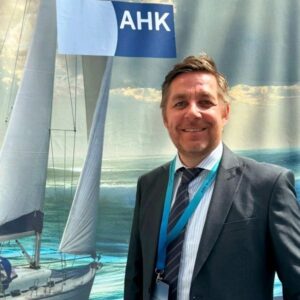
In an interview for Diplomacy&Commerce, Timo Pleyer, Director of AHK Kroatien, discusses German- Croatian business cooperation and the Chamber’s support for companies in both markets. He shares insights into specialised delegation programmes, renewable energy and industrial technologies, alongside initiatives that connect professionals and promote the visibility of women in engineering.
- AHK’s recent Economic Survey indicated that while companies in Croatia view their current business situation as stable, there is a growing caution regarding new investments and hiring. What are the main drivers behind this restraint, and how is the Chamber helping its members navigate this period of economic cooling in key European markets?
A company can have a solid order book today and still hesitate to expand tomorrow. That is the distinction our survey captures. Businesses continue to see Croatia as an attractive location, but higher operating costs and less predictable demand make the next investment decision more difficult. For companies connected to German customers and supply chains, developments in Germany inevitably influence planning here. If a customer postpones a project, a Croatian supplier has to reconsider its own capacity and recruitment. Add higher labour and energy costs, and the margin for error becomes smaller. Waiting can seem the safer choice, even when the company’s underlying business is sound. Our role is to help members assess their options. We support the search for business partners, provide access to market expertise and organise exchanges with companies facing similar decisions. Programmes such as European EnergyManager also address costs directly by helping employees identify viable efficiency projects. We cannot remove uncertainty from the market. We can help a company understand where it has room to act.
2. According to the same survey, the focus of managers has shifted from a pure labor shortage toward high labor costs and energy prices. In what ways is AHK engaging in dialogue with political decision-makers in Croatia to ease these pressures on economic competitiveness?
Higher wages are important for living standards and for retaining people in Croatia. Supporting sustainable wage growth also means strengthening productivity and helping companies invest in technology, skills and more efficient processes. These improvements enable businesses to offer better pay while maintaining their competitiveness. The priorities identified by our members provide a constructive basis for dialogue with policymakers: a predictable tax framework, legal certainty and efficient administrative procedures. Clear and timely processes help companies plan with confidence and devote more resources to modernisation, employee development and investment. Our German-Croatian Economic Forum brings business representatives together with policymakers and diplomatic partners. It provides an opportunity to exchange perspectives and discuss practical improvements to the business environment. Our contribution is to bring members’ experience into that dialogue and help identify solutions that support investment, employment and long-term economic development.
3. The Chamber has strongly positioned itself as a patron and partner of major sustainability initiatives, including the Green Energy Fair in Zagreb. How strong is the actual interest of German investors in Croatia’s renewable energy sector, and where do you see the biggest obstacles to a faster realisation of these projects?
There is tangible German involvement in Croatia’s renewable energy sector. But we should distinguish between a developer committing capital to a project and a technology company looking for customers. Both matter, and our energy programmes support business cooperation, but they tell us different things about investment. Croatia’s renewable resources offer opportunities. To turn those opportunities into an investment decision, a developer needs a credible timetable and a financial calculation based on reliable assumptions. Grid capacity, connection conditions and the coordination of permits are therefore central. A project becomes harder to finance when essential costs or completion dates remain uncertain.
4. AHK organises highly specialised projects, such as the Defence Innovation Tour to Germany and the From Smart Factory to Industrial AI delegation programme. Does this indicate a strategic shift in German-Croatian cooperation toward high-tech and defence industries, and how ready are local companies for such advanced integration?
These programmes reflect where we see opportunities for closer industrial cooperation. For a Croatian company, the relevant question is very concrete: what capability can it offer a German partner, and what would it need to improve to qualify for that business and the other way round. The Defence Innovation Tour creates access to companies and technologies that are difficult to understand from a distance. The opportunities extend to specialised suppliers in areas such as electronics, software and precision manufacturing. Entering these supply chains requires careful preparation. Technical quality has to be supported by reliable delivery, documentation and the ability to meet the requirements of the individual customer. The same practical approach applies to industrial AI. Our programme in Baden-Württemberg is designed around visits to companies and production sites, where participants can examine actual applications. A manufacturer needs to understand what a technology can do for its process before deciding whether it is worth the investment. Readiness varies considerably. Some Croatian companies can already contribute advanced expertise; others need to strengthen their production processes or digital capabilities first. A useful delegation helps both groups identify a realistic next step. A small supplier does not need to manufacture an entire system to become a valuable partner.
5. The Female Engineer of the Year initiative has now reached its fourth year in Croatia. How do you assess its long-term impact on the visibility of women in technical professions, and do partner companies recognise it as a vital tool for talent development?
A young woman considering engineering should be able to picture the career that might follow. Our finalists make that possible. They show what engineers actually do, how different their careers can be and how much responsibility women already carry in technology and industry.
In 2026, the initiative marked its fourth year, and Jelena Jurišić, CTO of Ericsson Nikola Tesla Group, received the award. All ten finalists provide a wider picture of engineering careers. That visibility matters because an unfamiliar profession can be dismissed long before a young person reaches the point of choosing a university course. We provide a sustained platform that gives these women greater visibility and brings their work to a wider audience. The involvement of partner companies reflects their commitment to supporting this effort. Giving women opportunities to develop, lead technical projects and progress into senior roles makes the public message credible. I would like the initiative to encourage that conversation as much as it encourages young women to consider engineering. As we further develop the project, we will complement the “Inspire.ing” aspect with a new element, “Empower.ing”.
6. As global economic trends and supply chains continuously shift, business associations must adapt as well. In which direction do you plan to further develop the services and support formats that AHK Kroatien provides, ensuring the Chamber maintains its position as the key accelerator of business and diplomatic ties between Germany and Croatia?
Our priority is to provide practical support that reflects the needs of our members, whether they are looking for a business partner, exploring a market opportunity or preparing their employees for technological change. Our newly established networking formats for Personal Assistants, HR Experts and Marketing Directors further strengthen the ties within our business community and provide a dedicated platform for meaningful exchange and networking. We continue to build on our specialised delegations and projects, with more opportunities for focused exchange and follow-up after initial meetings. Close cooperation with institutional and diplomatic partners will remain an important part of this work, helping us address shared challenges and support business cooperation between Germany and Croatia.