Our membership consists of a large array of companies with different backgrounds and industries. Another thing that sets us apart from other business associations is our integration into the worldwide AHK network. With over 150 locations in 93 countries, we are not just a chamber in Croatia – we are part of a global network that connects companies with German industry and international markets. This gives our members access to insights, partners, and opportunities that extend far beyond national borders, for Diplomacy&Commerce says Mr. Timo Pleyer, Director of the German-Croatian Chamber of Industry and Commerce .
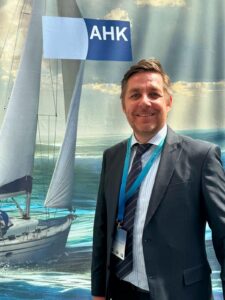
- AHK is one of the largest foreign chambers of commerce in Croatia. How many members do you have, what do you offer your members and how do you differ from the competition?
The German-Croatian Chamber of Industry and Commerce has over 360 members today, making us one of the largest and most influential foreign business networks in Croatia. Our core strength lies in bringing people and businesses together – we create connections that matter. We offer a wide portfolio of services, but what members value most are our networking opportunities and business delegations, complemented by projects that connect companies with innovation and sustainability topics. Our membership consists of a large array of companies with different backgrounds and industries. What they all have in common is a genuine belief in collaboration, which makes our business community open to new ideas and initiatives, which is something we are very proud of. This is also the feedback we receive from our members on a daily basis.
- How would you assess the economic relations between Germany and Croatia? Which segments of the economy and which industries dominate?
Germany was the main partner country for Croatian exports in 2024, accounting for around 12 percent of total exports, with an export increase of 2.3 percent to €2.9 billion. Imports from Germany rose by nine percent, reaching €6.2 billion. The main drivers are machinery, IT services, energy projects, and tourism. Germany is also a key supplier of industrial equipment, automotive parts, and chemical products, while Croatian companies provide IT solutions, food products, and increasingly, high-quality services. What is important is not only the volume but also the diversification of our bilateral exchange – we are moving from traditional trade toward more innovative and knowledge-driven cooperation.
- When we talk about investments, they are expectedly on the German side. What is the level of investment, how much is it two-way and what do you expect in the future when it comes to investments?
Germany has long been one of the leading foreign investors in Croatia, with a foreign direct investment stock of around €3.37 billion in 2023, according to the Croatian National Bank. What makes these investments remarkable is not only their size but also their quality – they are long-term, sustainable, and innovation-driven. German companies are not just bringing capital into Croatia, they are building production facilities, and partnerships that connect people, processes, and knowledge. Recent examples illustrate this dynamic very well. BMW and the Faculty of Mechanical Engineering in Zagreb (FSB) have entered into a strategic project to develop cutting-edge AI models for production – a cooperation that links Croatian academic excellence with industrial innovation from Germany. Porsche eBike Performance has chosen Croatia as the site for its future battery production, ensuring close cooperation between development in Zagreb and manufacturing in Sveta Nedelja. FRAMOS is investing more than €6 million in a high-tech campus in Čakovec to expand its vision systems business, while COBE’s Osijek office shows how German-Croatian collaboration in digital development is thriving. At the same time, we also see Croatian companies expanding into Germany, particularly in IT, engineering, and specialized services. A concrete example is Eccos, which has established its German subsidiary Deccos to provide advanced engineering, automation, and energy distribution solutions. This two-way investment flow shows that our economic ties are becoming more diversified and balanced. Looking ahead, I expect even stronger momentum in green energy, digitalization, and advanced manufacturing. Croatia’s EU membership, its stable eurozone environment, and the rapidly growing digital ecosystem make it an attractive location for German companies that are seeking nearshoring solutions and sustainable growth opportunities.
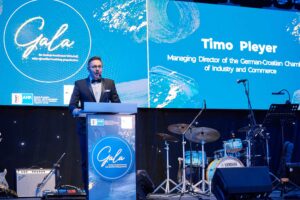
- How would you rate relations with legislators? How much do they listen to business people and their needs?
Constructive dialogue with policymakers is crucial, and I would say the willingness to engage is present in Croatia. However, there is still a clear need to reduce bureaucracy, accelerate digitalization of public services, and increase transparency. These are recurring messages from our members in this year’s Economic survey and from the business community at large. We as AHK act as a bridge: we listen to our members, channel their concerns, and present them in a structured way to decision-makers. Our surveys and position papers regularly highlight where reforms are most urgently needed – from tax and labor regulations to predictability in administrative processes. Progress is visible, but consistency and speed of reforms remain essential for improving Croatia’s competitiveness.
- AI is gaining momentum in everyday life and affects every segment of life. Where and how do you see the possibility for AI to improve the production process, decision-making, to be a tool for greater efficiency and not to potentially replace people in their jobs?
Artificial intelligence is undoubtedly one of the most transformative forces of our time. The debate often focuses on fears of job loss, but I see AI primarily as an enabler – a tool to make companies more efficient, to accelerate decision-making, and to open up entirely new fields of innovation. The key is to frame AI not as a substitute for human work but as a complement. Technology should free people from repetitive tasks, allowing them to focus on creativity, problem-solving, and value creation. At AHK Croatia, we are fostering dialogue on this issue through conferences and delegation trips. Croatia has established itself as a regional leader in highly skilled IT and engineering talent. With a strong academic foundation, a growing number of tech startups, and internationally recognized expertise in software development, data science, and artificial intelligence, the country’s professionals are increasingly sought after around the world. Croatian IT specialists are known for their innovation, adaptability, and quality of work.
- If we were to compare the economies of Germany and Croatia, what are the main differences and what do we here in Croatia need to work on in order to improve our business and raise it to a higher level?
Germany and Croatia share strong ties, but they operate on different scales. Germany, with its highly industrialized economy, leads in productivity, innovation, and global export strength. Croatia, while smaller, has made impressive progress – particularly with EU integration and infrastructure modernization. Moreover, Croatia is becoming an increasingly interesting supplier market for German companies. According to our latest Economic Survey, 86 percent of investors would choose to invest in Croatia again, which clearly demonstrates confidence in the country’s potential and business environment.