The niche segment in the region is no longer a margin, but a movement toward authenticity.
At DP Lux, we choose brands that stand behind their formulas and their stories, while Belodore delivers the kind of experience that keeps customers coming back, says CEO of DP Lux Group Miloš Milutinović for Diplomacy&Commerce. The niche is not about exclusivity for the sake of exclusivity – it’s about returning beauty to its essence: to brighten the day, emphasize one’s style, and remind us who we are. Our mission is for every customer to enter Belodore curious, and leave with a smile – and a scent they’ll love tomorrow as well. That’s why I believe in continued growth: thoughtful, responsible, and always driven by quality, says Milutinović.

1.DP Lux is one of the fastestgrowing companies in the region within retail and the beauty industry, particularly when it . comes to niche products. How familiar is the market with niche products, and in which segments do they exist?
The niche segment in the beauty industry today is much more than a small circle of collectors – it’s a conscious choice made by customers who seek products with character, a clear origin of ingredients, and an artistic signature. We’re talking about perfumes, skincare and hair care, as well as home fragrances, often produced in small batches, using carefully selected raw materials and controlled distribution. The regional market is becoming more educated every year: customers are looking for meaning, a story, longevity, and the evolution of a scent on the skin. They are no longer satisfied with generic “pleasant fragrances”; they want compositions that leave an impression and convey emotion. The strongest segments are luxury perfumes, advanced skincare with cleaner formulations, and limited collections available in specialized multibrand stores such as Belodore. What sets the niche apart is a deliberate decision not to take the path of least resistance: these fragrances are not designed to please everyone; they have the courage to be distinctive and to last. In skincare, this means that composition and results take precedence over marketing phrases. A niche customer is an active participant – choosing a signature, not a logo.
2. DP Lux currently operates in 15 European countries, with over 1,500 points of sale and more than 200 employees. Which of these 15 markets would you highlight from a business perspective, and what are the differences between the markets in terms of customer preferences and business conditions? (Some countries are EU members, others are not, with differences in legislation and collaboration with decision makers…)
DP Lux currently operates in 15 European countries, with nearly two thousand retail points and a team of over 200 colleagues. Looking at growth dynamics and the depth of consumer understanding, I would highlight Hungary, Serbia, and Croatia. Hungary is a prime example of market maturity – consumers there quickly embrace more complex compositions and trust brands with a strong creative direction. In Serbia and Croatia, we are seeing a strong influx of new customers entering the niche segment and a noticeable shift toward unisex categories, along with an increasing demand for fragrances with a distinct “signature” character. The differences are clear both in taste and in business conditions. The Mediterranean taste (Dalmatia, Istria, the Montenegrin coast) leans toward fresh, aromatic, and “sunny” notes that evoke clarity and airiness. The Central European palate (Budapest and beyond) is more open to woody, amber, and spicy compositions – often with a subtle sweetness and a warm, dry finish. When it comes to regulation, EU procedures are stricter but predictable and transparent; outside the EU, we enjoy greater operational flexibility and faster implementation, which requires proactive collaboration with decision-makers and institutions. We turn both environments into an advantage: in the EU, we build consistency in standards; outside the EU, we build agility and speed. The Belodore format allows us to curate our offer locally, time product launches strategically, and enhance sales advisor training so that the customer experience feels the same wherever you walk in – while the offer is smartly adapted to local preferences.
3.How and to what extent do global crises and inflation affect your business, and how do you anticipate the development of your industry in the coming years?
Inflation and broader uncertainty undoubtedly affect consumer habits, but the niche segment shows resilience. We observe two parallel phenomena: the “lipstick effect” – a tendency to indulge in small luxuries that enhance everyday life during challenging times; and premiumization– less frequent purchases, but more thoughtful and higher-quality ones. In our case this is reflected in the demand for perfumes with better longevity, a clear signature, and ingredients whose origin customers trust, as well as a growing interest in the purchase ritual and personalization. In the coming years, I expect three clear directions of growth: Transparency and sustainability – from raw material sourcing and responsible use to recyclable packaging and shorter supply chains.• Personalization – not just monograms, but expert advice in-store, layering, and pairing perfumes with skincare and home fragrances into a unique olfactory ecosystem.
• Experiential retail – Belodore does not just sell a product; we shape the ritual, knowledge, and personal time. This builds loyalty that outlasts market turbulence. For us, crisis is not an excuse but a lever for innovation: we focus on assortments that provide real value to the customer, optimize complexity, and invest in people and service.
4.In your opinion, what defines a premium brand, and what is the key difference compared to perfumes and products found in regular perfumeries?
Premium is not just a higher price – it is a culture of craftsmanship. In perfumes, this means top-quality raw materials, mastery in composition, and the courage to preserve the creator’s vision. A premium brand pays attention to every detail: concentration, projection, evolution on the skin, and the tactile experience of the bottle and packaging. The mass-market segment necessarily compromises to appeal to the “average” consumer, whereas premium and niche remain true to character, even if they target a smaller – but passionate – audience. The customer, therefore, receives expression instead of a template. As a company, we select brands with a clear pedigree, transparent formulations, meaningful stories, controlled distribution, and consistent service.
“IN THE BUSINESS WORLD, THE RULE IS DISCREET ELEGANCE. A FRAGRANCE SHOULD BE NOTICEABLE UP CLOSE, LEAVING AN IMPRESSION OF PROFESSIONALISM AND PERSONAL CULTURE, WITHOUT “INVADING” OTHERS’ SPACE”
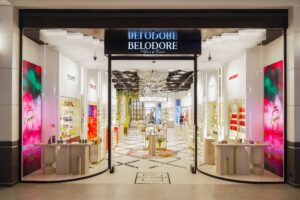
5. If we divide niche perfumes and products by regions and countries, where do the most popular ones come from? What do they inspire the customers to do, and what makes them special?
Historically, the epicentres of the niche scene are France and Italy, due to their traditions, composition schools, and access to premium raw materials. Over the past decade, the United Kingdom has also emerged strongly, while the Eastern Mediterranean and Middle Eastern cultural spheres contribute richer resinous, balsamic, and oud interpretations – often in modern, airy versions. In our markets – Hungary, Serbia, Croatia, and Montenegro – the most successful brands are those that successfully combine European elegance with the warmth and expressiveness of Oriental sensibilities:
• Hungary – openness to innovation and layered compositions; perfumes that “unfold over time”.
• Serbia and Croatia – strong growth of the unisex category and subtly distinctive signature perfumes that are office-appropriate.
• Montenegro – growth in luxury tourism drives demand for exclusive, limited collections; curated offerings build long-term loyalty.
These products are special because they draw inspiration from culture, landscapes, and materials; every bottle is a fragment of a story that the customer carries. When a perfume has identity, it becomes part of a personal narrative – something that lasts beyond a single trend.
6. Who is the more frequent consumer of your products, men or women? Is there a trend in the business world, and what do diplomats and ambassadors prefer?
Women still outnumber men in the niche segment, but men are the fastest-growing group. Today’s man experiences perfume as part of his style and communication: he wants a fragrance that signals neatness, reliability, and, when appropriate, a subtle sense of adventure. This drives the popularity of woody-spicy, leather, and aromatic compositions with a clean, dry finish. In the business world, the rule is discreet elegance. A fragrance should be noticeable up close, leaving an impression of professionalism and personal culture, without “invading” others’ space. We often recommend two strategies: a “daytime signature” – timeless, polished, and understated – and an “evening interpretation” of the same theme – deeper and warmer, for events and protocol occasions. Diplomats and ambassadors most often choose perfumes with a clear pedigree and composed complexity. Consistency of quality across batches and markets, as well as “readability” in different cultural contexts, is crucial. Here, our curatorial approach, staff training, and controlled distribution make a decisive difference.
7. What would you highlight as key for brand and business development: public relations, product quality, product perception, consumer lifestyle, ideas, the team you work with…?
For sustainable growth, we rely on three pillars: Product and quality – no compromises. In the niche segment, marketing cannot compensate for missing quality in ingredients or execution; we select brands that uphold high standards and consistently deliver excellence. Perception and experience – Belodore is an environment consisting of knowledge and rituals. Education, storytelling, personalization, and service quality create emotional value that is remembered and shared, from the first question to the advisor to the evolution of the fragrance at home. Team and partnerships – our 200+ colleagues are the key difference. Sales advisors listen, ask the right questions, and guide customers toward choices they will love long-term. Relationships with brands and institutions are built on trust and adherence to local regulations. ESG principles are part of this philosophy: responsible use of raw materials, recyclable or durable packaging, and preference for brands that transparently communicate ingredient origins. Digital tools and CRM help us personalize recommendations – from notes and seasons to occasions – reducing impulsive purchases while increasing satisfaction and return visits. Combined with a broad portfolio and presence in 15 markets, this approach provides scalability: we can quickly validate trends, implement them responsibly, and remain true to local tastes. This is why both niche beginners and seasoned collectors, as well as professionals from diplomatic and business circles, choose us.