The podcast is my way of reminding the people that health is not just the absence of illness, but a state of internal harmony .
The region we live in knows no borders when it comes to media, so its influence on all countries is limitless. The region is a shared space that expands opportunities and enriches content. One of the personalities present in the public space of Serbia, as well as across the region, is Adriana Čortan, the creator of the podcast Balansiranje, TV author, and presenter. She talks for Diplomacy&Commerce about her latest project Balansiranje, what it means in her case, and the influence and transformation of media in today’s world.
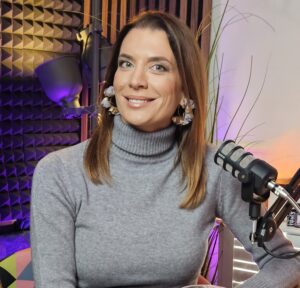
- You have been in the public eye for over 25 years as a journalist, author, and host of numerous television programs watched across the region. After many years working in one medium (television), how did you recognize the moment and the new age, and decide it was time to launch your own podcast, Balansiranje?
The idea for a podcast had been simmering inside me for a long time, not just because podcasts are trendy, but because I genuinely and deeply enjoy the format. After more than twenty-five years in television, I realized it was increasingly difficult for me to fit into short forms, strict durations, and predefined frameworks. The podcast gave me what I had been missing – freedom. A podcast is primarily listened to, and only then watched. There is no time constraint; the conversation flows as long as it makes sense and there is genuine exchange. That feeling is completely different – both for me and for the guest. In that space, there is no rush, no need to “cut” anything, no sensationalism. There is only conversation. I started Balansiranje from the heart, out of a personal need to find answers about health, meaning, emotions, and life crises, but also from a desire to share all of that with people. It is my personal space of truth, curiosity, and authenticity, where I explore together with my guests how to live healthier, happier, and longer – not only physically, but mentally and spiritually as well.
- In Balansiranje, you focus on balancing the mind, body, and soul. You speak about nature, health, and rituals – about how to live more consciously and achieve longevity. Why did you choose to focus on this particular niche, and how important is it today, in a time when everything is fast and often seems very superficial?
I began exploring these topics long before they became a “trend.” First through television, and then privately, because I realized that the conventional view of health was no longer sufficient. I’m glad that official medicine is increasingly embracing a holistic approach – that a person cannot be treated partially, but as a whole. Too often we treat consequences rather than causes. We put out fires without asking why they started in the first place. There is an old saying: you don’t treat the disease, you treat the person. And I am a deep believer of that. We live in a time of information overload, stress, and constant pressure to be productive, successful, and available. In that race, we lose contact with ourselves. For me, Balansiranje means asking: how are we truly living? Are we present in our own lives? Do we listen to our bodies? Do we nurture our thoughts, or do we leave them on autopilot?
- How do you choose your guests, and what must they have in order to capture your audience’s attention? Who are you addressing – what is your target group, considering that you focus on inspiring stories?
I choose my guests very intuitively, but also responsibly. What matters to me is that they have knowledge, experience, and integrity. They are mostly experts in medicine, psychology, nutrition, science, but also individuals with powerful personal stories. I’m not interested in perfection – I’m interested in authenticity. People who have gone through crises, setbacks, and transformations. Those who understand that knowledge alone is not enough without empathy and humanity. Balansiranje is not an elitist podcast. It speaks to everyone – both young and old, those just beginning a journey and those who have already experienced a great deal. I believe that the question of health is universal and concerns every family. The message I consistently share is that change begins with us. When we change, the world around us changes too.

- Given your many years of experience, how do you view new communication channels – from social media to podcasts? How strong is their influence, and to what extent does quality break through amid the quantity? Do they complement mainstream media, or are they gradually replacing them, especially considering age groups and target audiences?
I don’t believe television will disappear, but I do believe its influence is changing. Young people today hardly watch traditional TV programs at all. They choose the content, they choose the timing, and they choose the topics. Podcasts and social media have one major advantage – the audience comes because they want to, not because they have to. There is no manipulation, no hidden agendas. Everything is transparent. You build a community of people who think similarly, ask questions, and engage in dialogue. Quality has a harder time breaking through today because there is simply too much content. But precisely because of that, when it does break through, it forms a much stronger bond with the audience. Balansiranje is not a mass product, but it is an honest story. And I believe that is exactly where the future of media lies – in authenticity, not in spectacle.
- How do you personally find balance in life? What does Balansiranje mean to you?
Honestly – I am learning every single day. Balance is not a state you reach once and stay in forever. It’s a process. Some days I manage it better, some days less so. For me, balance means listening to myself. Noticing when I’m tired, when I need a break, when I need silence. I’ve learned that I don’t have to be available to everyone all the time and that I have a right to my own time. Choosing peace over chaos, awareness over autopilot, and truth over playing a role – that, for me, is the essence of balancing.
- Considering the topics you deal with, what do you pay attention to and what are your areas of interest? Do you have a message for our readers, who mostly work in sedentary jobs or feel they don’t really have time for balance in their lives? Or is there, after all, time for everything?
Most people live in a seated position – both physically and mentally. They sit in jobs they don’t love, in relationships that don’t nourish them, in lives they didn’t consciously choose. We often say we don’t have time, but the truth is that we often lack priorities. Time for yourself is not a luxury – it’s the foundation of health. It doesn’t require an hour of yoga or a perfect routine. Five minutes of silence, a short walk, one honest question to yourself – how am I today? – can be enough. Small changes make a big difference. Balance doesn’t mean a perfect life; it means a conscious life. And that is the only investment that always pays off.