Presidency unfolds at a moment of profound geopolitical complexity and uncertainty.
This marks the second time in its history that Cyprus has assumed the Presidency of the Council of the EU, following its first term in the second half of 2012. We approach this responsibility with a strong sense of duty and full awareness of the expectations, for Diplomacy&Commerce says H.E. Andreas Ignatiou, Ambassador of Cyprus to Croatia. Our ability to adapt to everyday challenges rests on several essential elements: political determination, flexibility, continuous monitoring of European and global developments, and above all, readiness, the ambassador adds.
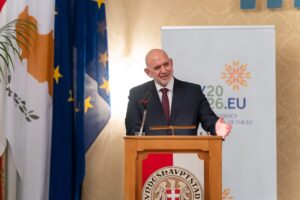
- After 14 years, Cyprus took over the rotating presidency of the Council of the EU on 1 January. It has already been 2 months since the takeover in very turbulent times. Let’s recall what the priorities of the Cyprus presidency are and what is the focus?
Cyprus, together with its Trio Presidency partners, Poland and Denmark, underscores the urgent need for a Union that is strategically autonomous while remaining open to the world. Strategic autonomy is the common thread running through the five priority pillars of the Cyprus Presidency.
First, autonomy through security, defence, readiness, and preparedness. Russia’s illegal invasion and continued occupation of Ukraine have underscored the need to strengthen Europe’s defence readiness and capacity to act independently when required. Supporting Ukraine in every possible way will, of course, remain our highest priority. At the same time, the Cyprus Presidency will actively support key defense initiatives and prioritize the effective implementation of the White Paper on the Future of European Defence, as well as the Readiness Roadmap 2030.
Second, autonomy through competitiveness. Europe’s competitiveness underpins its resilience and strategic capacity. The Presidency will promote a streamlined and predictable regulatory framework to support businesses while advancing regulatory simplification. Completing and strengthening the Single Market, the green and digital transitions, and reducing energy and raw material dependencies, also remain essential.
Third, an autonomous Union open to the world. Strategic autonomy does not imply isolation, but confident global engagement. The Cyprus Presidency will work to strengthen the EU’s global role through effective use of its policy instruments and deeper partnerships. Enlargement remains a transformative EU policy, and Cyprus is firmly committed to advancing a credible, merit-based enlargement process in line with strict conditionality.
Fourth, an autonomous Union of values that leaves no one behind. Europe’s strength lies in its citizens and shared values: democracy, the rule of law, and fundamental rights. The Presidency will work to reinforce the rule of law, strengthen social cohesion, address poverty, and promote access to affordable housing, energy, and safe food.
Fifth, a long-term budget for an autonomous Union. Strategic autonomy must be underpinned by adequate financing. The Multiannual Financial Framework for 2028–2034 is the Union’s key instrument for delivering its long-term objectives. Building on progress achieved, the Cyprus Presidency will advance negotiations constructively and transparently, with the aim of delivering a mature negotiating framework to facilitate timely agreement at the European Council.
- In the given circumstances, how far is it possible to implement the given policies and how do you adapt to everyday challenges?
As I noted earlier, our priorities have been shaped to a significant extent through close cooperation with our Trio Presidency partners. This continuity has already allowed for tangible progress.
In our view, the key question is not whether these policies can be implemented, but whether the Union will demonstrate the decisiveness required to do so. Precisely because of the prevailing geopolitical context, it is imperative that the priorities of the Cypriot Presidency move decisively from discussions to concrete political action.
We are encouraged by the fact that the EU is already demonstrating a strong determination to advance towards a more autonomous Union across the political, social, and economic spectrum, in line with our Presidency priorities. It is this collective determination that underpins our confidence in the feasibility of implementation.
Naturally, the path forward is not without obstacles. As we have already witnessed during the first months of the Cypriot Presidency, unpredictable and serious developments can arise at short notice. Challenges that, only a decade ago, might have appeared impossible are now being confronted and overcome through coordinated action.
Two recent examples illustrate this clearly. First, the agreement by EU leaders in December to grant a €90 billion loan to Ukraine, reached under the Danish Presidency, followed by the agreement on the legal framework for delivering this assistance on 4 February under the Cyprus Presidency. Second, the strong display of unity, support, and solidarity shown by Member States towards Denmark and Greenland, reaffirming their sovereignty and territorial integrity.
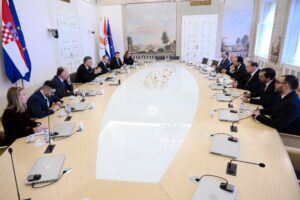
- To what extent do European procedures and processes affect the efficiency of conducting European policies in general and how does official Nicosia see the role of Europe and the EU in the years to come (strengthening the EU’s defense capabilities, a more competitive economy…)?
The EU is, at its core, a Union of sovereign states that made a conscious decision: that the European continent had endured enough war, destruction, and loss of life. On that foundation, Member States have demonstrated a remarkable capacity to engage in dialogue, to cooperate, to understand each other’s perspectives, and to reach decisions that take into account a wide range of interests, priorities, and sensitivities. It is worth underlining that there is no other multilateral format in modern history that has proven equally capable of delivering collective decisions with such speed, effectiveness, and impact.
That said, we do not claim that European decision-making is flawless. A Union of 27 partners cannot, by definition, act with the same speed as a single nation-state. There is room for further improvement, and we should continue working towards more streamlined and efficient procedures, while fully respecting national concerns, and legitimate sensitivities.
From the perspective of Cyprus, and indeed shared by partners such as Croatia, smaller Member States see strong value in a Union that combines effectiveness with inclusiveness. Effectiveness is achieved when all Member States feel heard and engaged in the outcome.
Looking ahead, Nicosia sees the EU playing an increasingly central role as a geopolitical, economic, and security actor. Strengthening Europe’s defence capabilities, enhancing strategic autonomy, and building a more competitive economy are not abstract ambitions, they are practical necessities. Europe must therefore continue to evolve in support of these goals, ensuring that the Union remains capable of acting decisively, in an increasingly complex global environment.
- Cyprus and Croatia are members of the EU and share the same values. There are no open issues, but where do you see room for progress in relations between the two countries?
Membership in the EU implies the adoption of a common set of principles and values: democracy, the rule of law, open and inclusive societies, respect for international law, and the protection of fundamental human rights. These are not abstract notions; they constitute our moral compass and are embedded in every aspect of our policymaking.
In this regard, we are particularly pleased to share these values with Croatia, a country with which we also share common historical experiences, including the tragedy of war and the enduring humanitarian issue of missing persons.
Cyprus is not a member of NATO. The current geopolitical circumstances do not allow Cyprus, a country of particular strategic importance, to access or apply for membership in the Alliance. This is due to the persistent denial by a NATO member of an objective and universally recognised reality: the existence of the Republic of Cyprus, a full member of the United Nations and the EU. This situation inevitably constrains Cyprus in fully realising the spectrum of defence cooperation with European partners, including Croatia.
That said, NATO is not the sole avenue for deepening defence cooperation. Significant scope exists within the EU framework, notably through PESCO, as well as through bilateral arrangements. The conclusion of Memoranda of Understanding on defence cooperation represents a realistic path forward.
Beyond defense, we see additional opportunities for enhanced cooperation in areas such as improved connectivity, increased trade flows, and deeper collaboration on maritime safety. In this latter field, our two countries already work together through a joint Croatian–Cypriot Centre of Excellence, which provides a solid platform of cooperation.
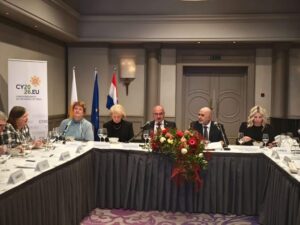
- Economic parameters are one of the important indicators of how relations develop. What do the numbers show, bearing in mind that both countries are tourism powers and that they are located in the Mediterranean, and that they share the same “cake” of tourism?
I have already referred to the shared values that underpin all dimensions of our bilateral relationship. At the same time, economic relations remain a decisive factor in shaping relations between states. From that perspective, the potential for strengthening economic cooperation between Cyprus and Croatia is considerable.
Indeed, as Mediterranean countries, both Cyprus and Croatia are widely recognised as tourism powerhouses. We offer high-quality tourism services, supported by exceptional natural beauty and rich cultural heritage. However, it would be an oversimplification to suggest that Cyprus and Croatia are merely “sharing the same cake” in tourism. On the contrary, there is significant scope for partnership, exchange of best practices, and mutual learning, which can allow both tourism sectors to grow further rather than compete at each other’s expense.
Moreover, both countries are increasingly investing in diversified tourism, including cultural tourism, city breaks and gastronomy. This diversification opens the door not only to new markets but also to increased tourism flows between us. From personal experience, I can confirm this dynamic. I encounter a growing number of Cypriot visitors in Zagreb, drawn by the city’s history, cultural life, and local cuisine.
- How do you see Croatia from Vienna and what do you most like to visit when you’re here? What do you like about our gastronomy, and what would you recommend we definitely see and try when we go to Cyprus?
I try to visit Zagreb as often as possible, especially during the period when Cyprus holds the Presidency. Despite the demanding schedule, I always enjoy a walk around Ban Josip Jelačić Square, the beating heart of the city, and the nearby streets. I also enjoy exploring the old town with its unique architecture and atmosphere. The area around Zagreb Cathedral, St. Mark’s Church, where the Sabor and Banski dvori are located, as well as Lotrščak Tower, are among my personal favourites.
In terms of gastronomy, I find that both Croatians and Cypriots share a strong love for good food. Our cuisines are based on authenticity, regional diversity, and traditions passed down from generation to generation. The use of fish, olive oil, fresh herbs, and wine is something we naturally have in common. In Zagreb, I never miss the opportunity to enjoy štrukli and ćevapi, while fritule are a particular favourite, not least because they are similar of a traditional Cypriot sweet and feel pleasantly familiar.
As for Cyprus, I can assure Croatian visitors that the island often exceeds expectations. Despite its size, Cyprus offers remarkable diversity: from sandy beaches to pine-covered mountains and panoramic views, within less than an hour’s drive. Wherever one goes, traces of an ancient civilisation unfold, ancient theatres and temples standing alongside medieval Byzantine churches and monasteries, bearing witness to the island’s long history.
Cyprus also offers something for different tastes and interests. It is well known for its vibrant nightlife, but it is equally rewarding for culinary enthusiasts. Cypriot food blends Eastern Mediterranean influences into a distinct Cypriot cuisine, shaped by local products, generous portions, and warm hospitality. Rather than recommending a specific dish, I would simply suggest visiting a local taverna, where you will likely have the chance to try many traditional flavours.