Although France is Croatia’s 9th trading partner and 11th partner in termsmof cumulated foreign direct investment, more than 50 French companies operate in Croatia and employ more than 5,000 people.
The relations between Croatia and France have gained momentum in recent years, from political to economic, but also cultural and archaeological. H.E. Fabien Fieschi, Ambassador of France to Croatia has been in Zagreb since 2023, and he reveals his impressions and experiences he gained while staying in the capital, but also everything that the work and life of a diplomat brings. About the politics, economy, culture and life of the French ambassador, Mr. Fieschi talks for Diplomacy&Commerce magazine.
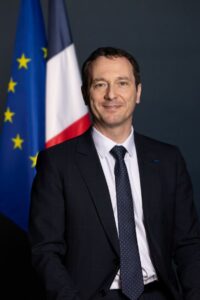
1. Relations between Croatia and France seem to be at an all-time high. This is supported by the fact that the two countries have signed a Strategic Partnership, which is the foundation of bilateral relations, with an emphasis on strengthening political, economic, defense and security cooperation. How is the agreed cooperation being implemented and which areas are the most dominant?
I fully agree with you regarding the excellent development of our bilateral relation in recent years. The most powerful and visible aspect of the implementation of the Strategic Partnership Agreement has without any doubt been the on-time delivery of the 12 Rafale multi-mission jet fighters purchased by the Croatian Air Force: I was on the Pleso airbase when the first 3 Rafale were delivered, and I realised how important a step it was in ensuring the long term sovereignty of Croatia, but also how it would anchor our bilateral cooperation in the field of defense.
I could also mention our very close cooperation in the field of security: our police officers, prosecutors, custom officers work jointly to fight different forms of organised crime and protect European borders, contributing to the security of our citizens, but also sharing their experience and best practices with countries in the region who want to join the European Union. We also have beautiful cooperations in the field of archeology, share our experience in the restauration of Cathedral Notre-Dame and the Cathedral of Zagreb, or support artist residences in the field of graphic novels and comic books. But one of the most important aspects of our strategic partnership is also the less visible: the countless exchanges of views and coordination at all levels, from civil servants to the Prime Minister and the President, on European affairs. France and Croatia are both member of the EU family and of NATO: by working jointly and designing better policies at the European level, we build a stronger, more competitive, more sovereign Europe, and thus reinforce the prosperity and security of our nations and our citizens.
2. Experience shows that the level of economic cooperation, perhaps, best reflects the relations between two countries. What do the numbers show when we talk about investments, trade and general economic relations between the two countries? How much is the exchange, investments, which industries dominate?
The numbers show that, because of history and geography, France and Croatia have not been among the closest partners: according to our figures, France is Croatia’s 9th trading partner, behind in particular some of its immediate neighbours, and its 11th partner in terms of cumulated foreign direct investment. But this is only one part of the story, as we count more than 50 subsidiaries of French companies in Croatia, who employ more than 5.000 persons locally. And since my arrival I have witnessed a trend: more French companies seem to consider that Croatia, now in Schengen and in the Eurozone, is a good place to set up a regional headquarter for the Adriatic or even the Southeast Europe region. Our trade has also been increasing rapidly over the past 5 years, crossing for example the threshold of more than 1 billion euros of French exports to Croatia in 2024. France has had traditionally a trade excedent with Croatia, but it is compensated by the Croatian excedent in services, partly thanks to the more than 600.000 French tourists who visit the country every year. Our exchanges are quite diversified: chemical and cosmetics, transportation (cars, but also sailing boats), infrastructures such as the Zagreb airport and the highways in Istria, agrifood, consumer goods, insurance or digital services.

3. Two countries are members of the EU and NATO, but Croatia also aspires to membership in the OECD. How does official Paris support Zagreb’s efforts, and what advice can you give to decision-makers considering the conditions that need to be met? What are the experiences of France as one of the founders of that organization, and the headquarters of the OECD is in Paris?
France has been supportive from the outset of the candidature of Croatia to the OECD. This support has been political, but also technical: being a founding member and the Host Country of the organisation, we have a long experience of its policies and its internal dynamics, including the process of admitting new members. Representatives of our ministries, and also the staff our Permanent Representation to the OECD in Paris have therefore met many times with the Croatian negotiating team, provided advice and shared experience. I must say that Croatia, having successfully completed the accession process to the European Union, or more recently to the Eurozone and to the Schengen area, has a lot of experience and skills when it comes to answering requests and recommendations from the OECD members, and introducing legislative and regulatory reforms in that view. Croatia has already met the requirements in most of the OECD committees and is getting closer to meeting all the requirements. Now, of course, beyond the adoption of reforms, and beyond the formal accession to the OECD, it will be important for Croatian authorities to remain focused in the first years on the concrete implementation of those reforms to rip all the benefits from its membership.
4. France is known for its rich tradition, which it represents all over the world. What have Croatians recognized and accepted from your rich heritage, and how is cooperation developing in that direction?
Though their geographic position is different, France and Croatia share some common features, such as having been at the crossroads of several cultural areas, and having received the influence of multiple culture, some of which we have in common, such as the Roman, Mediterranean and Christian culture. This is why we nowadays have for example very fruitful cooperation in the field of archeology, but it is also a reason why we share the culture of wine. I have met with many Croatians who enjoy French wines in their diversity, and it was also a pleasure for me in Croatia to taste and discover local cépages. Many exchanges took place over the centuries between France and Croatia, from the scientific career of Ruđer Bošković in Paris to the success of Molière’s plays in Croatia, or the mutual respect and friendship between sculptors Auguste Rodin and Ivan Mestrovic. Nowadays, many French authors are published in Croatian every year, but some Croatian novels like „Red Water“ (Crvena voda) by Jurica Pavičić have also met French audiences and critics with success. Nevertheless, I think there are still many aspects of French culture and traditions to be discovered by the Croatian public. For a long time, I think that French items, products or touristic destination were seen as attractive but not easily accessible; but my feeling is that this is changing and I hear more and more Croats talking to me about their recent vacation in France or trip to Paris, being fans of French brands, or enjoying French food and wine.
5. Culture and art is the key to the identity of every nation and people, as well as education. Some time ago, a meeting called„ French–Croatian Cooperation in the Context of Europe and Higher Education“ was held at the Croatian Catholic University, dedicated to strengthening French-Croatian cooperation in the field of higher education, science and culture. What are the conclusions and concrete results of that event, as well as similar ones when we talk about cooperation in education?
Young people are our future, so it is important to get them involved in the development of our bilateral relations. Erasmus has probably been one of the most concrete, important and successful programs put in place in the framework of the European Union: it has changed the life of so many people and created among them a sense of being members of the same European family, beyond our rich cultural differences and languages. So, it is important for the French Embassy in Zagreb to invite deans, professors and students to take advantage of those possibilities and develop exchanges between French and Croatian Universities. This event at the Croatian Catholic University was a good occasion to highlight the large number of partnerships between this university and French universities in different regions of France, explore more opportunities for exchanges, but also meet directly with Croatian and French students and exchange about the future of Europe. We also organised in March a full day of exchanges, along the same principles, with the University of Zagreb, where the University of Toulouse in France proposed to develop new exchanges in the framework of European University Networks, and where students were also able to meet with representatives of French companies in Croatia to explore job opportunities.
6. You have been in Croatia since 2023. What did you know about our country when you arrived at the beginning of your mandate, and what are your experiences today? What would you like to recommend to friends to visit or try in terms of gastronomy in Croatia? And what would you suggest to our readers to visit or try in terms of food and drink in France, other than those worldfamous places?
I must admit I was not very familiar with Croatia, as I had spent most of my diplomatic career abroad in Japan and the United States. I remember though I had an occasion to visit Croatia around 1999, when I was dealing in Paris with the issue of the prohibition of antipersonnel landmines and the Croatian government organised a big international conference on this theme: after the conference in Zagreb we were taken to the Plitvice lakes to commemorate the fact that they had just been cleared from landmines, and I was struck by the stunning beauty of the lakes, which I have visited again many times since my arrival as an Ambassador. This is definitely a place where I enjoy to go every time I have friends visiting from France. Of course, I had the chance to visit many of the beautiful cities on the Dalmatian coast, in Istria, as well as several beautiful islands. But I must say I also enjoy the beauty and rich cultural heritage of cities like Varaždin and Osijek. In all those places, I would recommend my friends to try and enjoy the local delicacies, as they illustrate the great diversity of Croatia and its regions. Diversity is also something that defines France’s landscapes, culture and food, so I would make the same recommendation to Croats who want to go to France: if it’s your first time, yes, definitely visit Paris and some wonders that are very close, such as Versailles and Fontainebleau, or painter Monet’s house and garden in Giverny, or a bit further, such as Mont Saint-Michel in Normandy, or Reims in Champagne. And if you have already been there, explore our regions one at a time, there is so much difference between Alsace in the East and Bretagne in the West, Provence, Bourgogne and Dordogne… and in all those regions you have lovely villages and excellent food!