Around 100 Swiss companies operate in Croatia across a variety of sectors.
Strong political relations provide a solid basis for dynamic and resilient economic cooperation, and the figures clearly illustrate the strength of Swiss-Croatian relations. Switzerland and Croatia enjoy a constantly developing economic relationship, characterized by growing trade in goods and services, as well as increasing levels of investment. In fact, bilateral trade is relatively well balanced, H.E. Beatrice Schaer, Swiss Ambassador to Croatia, tells Diplomacy&Commerce. As of the beginning of 2026, and after nine years of transitional arrangements, Croatian citizens now enjoy full freedom of movement in Switzerland – on the same basis as citizens of other EU Member States – in accordance with the Agreement on the Free Movement of Persons, Ambassador Schaer reminds.

- Croatia and Switzerland seem to have excellent relations from political to economic. Where do you see room for improvement in these relations and in what way? Are there any open issues between the two countries?
Since taking up my post as Swiss Ambassador in Zagreb, I have been approached by several Swiss companies expressing interest in establishing a presence in Croatia. This is a very positive development, as we see considerable untapped potential in both trade and investment. With the agreement on the free movement of persons between Switzerland and the EU, as well as our recently updated bilateral double taxation treaty, the framework conditions are highly favourable. We are also pleased that, since the beginning of 2026, and following nine years of transitional arrangements, Croatian nationals now enjoy full freedom of movement in Switzerland—on the same basis as citizens of other EU Member States—under the Agreement on the Free Movement of Persons .
2. The two countries hold regular political consultations at the level of the Ministry of Foreign Affairs. What topics dominate such meetings and what can one country offer to another for a better and better quality of life for its citizens? What do you learn from Croatia, and what do you think we could learn from the Swiss?
Next year marks the 35th anniversary of our bilateral relations, an important milestone for both Switzerland and Croatia. Our regular political consultations offer an excellent opportunity to review the state of these relations, which remain very strong. The discussions during such meetings cover a wide range of topics— from political and economic cooperation to collaboration in multilateral fora and many other areas. I would like to highlight last year’s official visit on 16 September by the then President of the Swiss Confederation, Karin Keller Sutter, to Zagreb, where she met with President Zoran Milanović, Prime Minister Andrej Plenković, and the Speaker of Parliament Gordan Jandroković. This year, in October, the President of the Council of States of Switzerland, accompanied by a delegation, will pay an official visit to Croatia. Later in the year, we also expect a highlevel Swiss economic delegation. These visits underscore the importance and dynamism of our bilateral relations. The impressive turnout at this year’s Swiss Evening further underscored the vitality of our relationship. Regarding your question—what Switzerland learns from Croatia, and what Croatia might learn from Switzerland—I would like to emphasize the excellent cooperation between our countries in the fields of education, research, and innovation. Direct contacts between researchers, institutions, and funding agencies in both countries form the backbone of this collaboration. These personal and institutional links are the best guarantee for highquality partnerships and for the continuous exchange of knowledge and expertise.
3. Good political relations are always a prerequisite for good economic relations. The numbers seem to be on Switzerland’s side. What do these numbers show, how much investment, trade, which industries and sectors dominate?
In 2025, Swiss exports to Croatia amounted to CHF 427 million, while imports from Croatia reached CHF 345 million. Trade is particularly strong in pharmaceuticals, machinery, chemicals and food products. When trade in services is taken into account, however, the picture looks different: Swiss exports of services totalled CHF 101 million, while imports from Croatia reached CHF 265 million, largely driven by tourism. This results in a surplus in Croatia’s favour and highlights the importance of tourism in our economic relationship. Each year, around 300,000 Swiss tourists visit Croatia, and the country continues to grow in popularity as a travel destination. I myself was among these tourists, long before I took up my position as Ambassador in Croatia. Investment represents another key pillar of our economic cooperation. Swiss companies have made substantial and long‑term investments in Croatia, and Switzerland currently ranks as the twelfth largest foreign investor. Given current trends, there is every reason to expect Switzerland to soon return to the group of the top ten investors. Approximately 100 Swiss companies are active in Croatia, spanning a broad range of sectors and creating several thousand jobs. These companies operate in fields such as wood processing, glass packaging, electrical insulation materials, pharmaceuticals, IT and other high‑value industries, and together they provide a very representative snapshot of the Swiss economy. They include a small number of large companies and multinationals, alongside many small and medium‑sized enterprises, which form the backbone of Swiss industry. Most of them are members of the Swiss‑Croatian Business Association (SCBA), an important networking platform that supports economic ties and facilitates business cooperation between our two countries. More broadly, Swiss companies are attracted to Croatia by several key factors: a skilled and well‑educated workforce, strong foreign‑language skills, Croatia’s favourable geographic location and its close proximity to Switzerland. Croatia’s EU membership has also significantly simplified business operations and regulatory alignment. In recent years, we have observed growing interest from Swiss investors, with particular attention being paid to the IT and digital sectors, which offer strong prospects for future cooperation.

4. The “Swiss Government Excellence Scholarships” program promotes international exchange and research and academic cooperation between Switzerland and more than 180 countries around the world. Croatia is one of them. What is this program like and what are the concrete results in Croatia and other countries?
The Swiss Government Excellence Scholarships programme is a long‑standing and highly regarded instrument for promoting international exchange, academic excellence and research cooperation between Switzerland and more than 180 partner countries worldwide, including Croatia. Through this programme, Switzerland invests not only in outstanding individual talent, but also in the creation of sustainable academic and professional networks that endure well beyond the scholarship period. The programme is designed to support talented young researchers and artists by enabling them to pursue advanced research or artistic projects at leading Swiss institutions. Each year, Croatian citizens may apply in one of four categories: research fellowships, PhD scholarships, postdoctoral scholarships and art scholarships. The call for applications for the 2027–2028 academic year will be published on the webpage of the website of the Agency for Mobility and EU Programmes: www.ampeu.hr in September 2026. Since Croatia’s independence, a total of 70 Croatian citizens have been awarded Swiss Government Excellence Scholarships. They come from a wide range of academic and artistic fields, including medicine, natural sciences, engineering, the humanities and the arts. The concrete results of the programme are visible not only in academic output, but also in human capital. Many former scholarship holders today occupy prominent positions and are recognised authorities in their respective fields, contributing to scientific progress, cultural life and innovation both in Croatia and internationally. Some of them are also well known to the wider public, which further highlights the programme’s broader societal impact. Importantly, the alumni of the Swiss Government Excellence Scholarships form a vibrant and influential network. In many ways, they act as ambassadors of Switzerland, embodying Swiss values such as excellence, openness and innovation. Their personal and professional connections represent a strong and lasting bond between Switzerland
and Croatia and illustrate how academic cooperation can translate into enduring partnerships between nations. A recently organized gathering of these alumni was proving this.
5. How engaged you are is also demonstrated by the recent signing of the first contracts within the framework of the “Civic Engagement Program of the Second Swiss Contribution”. How much do Croatia need such contracts, what is the response of associations and partners, and what are the visible results?
The Civic Engagement Programme is one of the four programmes that are financed within the framework of the Second Swiss Contribution in the Republic of Croatia. The signing of the first contracts under the Programme highlights Switzerland’s strong engagement and responds directly to Croatia’s needs to further strengthen civil society and democratic participation. The Programme was designed in close cooperation
with Croatian institutions to support organisations in reducing social and economic disparities and fostering inclusive communities. The response from associations and partners has been highly positive, reflecting Croatia’s vibrant civil society. The strong involvement of Swiss partners in most projects further confirms the value of bilateral cooperation and mutual learning. As for visible results, the Programme is already translating ideas into concrete action on the ground. The supported projects focus in particular on promoting civic participation – especially through increased volunteering – as well as on education for sustainable development, including empowering young people with the knowledge, values, and skills needed for active citizenship. While many outcomes are yet to be seen, the expected impact is both immediate and long-term: strengthened organisational capacities, greater citizen engagement in democratic life, and the creation of models and practices that can be scaled up for broader, systemic impact. Ultimately, these efforts contribute to building more resilient, inclusive, and democratic communities across Croatia.
6. Switzerland is landlocked, but a drop of rain that falls in the Swiss Alps reaches four different seas. This is due to Switzerland’s unique location in the heart of Europe. Here, the Alps form one of Europe’s main watersheds. That’s just one of the interesting facts about your country. What else would you recommend to anyone who visits it to see, try food, etc.? And what is it that you would gladly advise your friends to visit and try in Croatia?
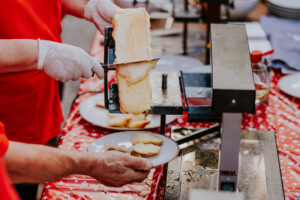
Switzerland may be a small country, but it offers an impressive degree of cultural, linguistic, and geographical diversity. Within just a few hours of travel, you can move between different languages, traditions, cuisines, and landscapes— from alpine mountain villages to Mediterraneanstyle towns in the south. It’s almost impossible to narrow down the places worth visiting, but I would certainly encourage experiencing both the beautiful Alpine scenery and the everyday Swiss way of life. Scenic train journeys such as the Glacier Express are unforgettable, and exploring Switzerlands many villages and cities shows its regional character. In the SwissGerman region, I recommend Appenzell for its colorful houses and traditions; in Frenchspeaking Switzerland, the Lavaux vineyard terraces (UNESCO World Heritage Site) above Lake Geneva are stunning; in Italianspeaking Ticino, Morcote enchants with stone alleys, subtropical plants, and hidden churches; and in the Romanshspeaking region, the Engadin valley offers great alpine landscapes and beautifully preserved villages. The culinary side of Switzerland is just as diverse. Beyond the wellknown fondue and raclette, I recommend trying Rösti, a crispy potato dish somewhere between hash browns and a potato cake, or Züri Geschnetzeltes, thinly sliced veal in a creamy mushroom–white wine sauce, typically served with Rösti. If you visit the canton of Grisons—my home region—you must try Capuns, spätzlelike dough wrapped in Swiss chard leaves and cooked in cream and broth. And for dessert, the Nusstorte, a rich caramelwalnut tart, is a classic. Although Swiss wine is not widely known internationally, the country produces excellent white and red wines, most of which are enjoyed locally rather than exported. As for Croatia, I would encourage friends to explore not only the stunning Adriatic coast and historic cities such as Dubrovnik, Split, and Zadar, but also the local cuisine, island culture, and natural treasures like Plitvice Lakes National Park. They must try a Burek and Ćevapi with a local beer, and on the coast, a black risotto or fresh Adriatic seafood paired with one of Croatia’s outstanding wines. And to help digest all the delicious food, I’d recommend a glass of Pelinkovac. Živjeli!