The most valuable indicator of success is indeed the fact that doctors are returning home.
Waiting times for healthcare services are the most visible challenge – the one that troubles patients the most – both in Europe and in Croatia, Minister of Health, Assistant Professor Irena Hrstić, PhD, told Diplomacy&Commerce. In addition to the significant investments already made – from hospitals and human resources to innovative medicines – she announces new ones. Minister Hristić adds that Croatia is above the European average in key indicators of citizens’ healthcare protection.

- How would you describe the state of Croatia’s healthcare system today, and what are you most proud of since taking the helm of the Ministry?
It is an undeniable fact that we have invested nearly three billion euros in the healthcare system – specifically in hospital reconstruction, the procurement of state-of-the-art equipment, digitalization, and strengthening of human resources. However, for me personally, the most important measure is not financial, it is rather our patients, who truly feel these changes.
The comprehensive reconstruction of Merkur Clinical Hospital has been completed, making it the first fully renovated hospital in earthquake-affected Zagreb. Work has also been completed on two major clinics of KBC Zagreb – the Department of Obstetrics and Gynecology Petrova and the Clinic for Lung Diseases Jordanovac – as well as at KBC Sestre milosrdnice, while the third phase of construction at KBC Zagreb is progressing in parallel.
In the field of oncology, particularly radiotherapy, we have launched the largest investment in medical equipment in the history of Croatian healthcare. Through the National Recovery and Resilience Plan (NPOO), we have procured 21 new linear accelerators, with a total value of 85 million euros, distributed across six hospitals throughout Croatia. Currently, 16 new and four existing machines are in operation, and by the end of May, when they are all to be fully operational, Croatia will surpass the European Union average with a total of 25 accelerators, or 6.4 devices per million inhabitants.
I am especially proud of the projects that have permanently improved access to healthcare services for all the citizens: the helicopter emergency medical service, a network of fast boats for islands and coastal areas, as well as mobile clinics and pharmacies for rural regions.
The Croatian Medical Chamber has recorded a continuous rise in this trend since 2023, especially among experienced specialists who have recognized Croatia as a place for further professional development and a better quality of life. That speaks louder than any statistic. After the wave of departures following Croatia’s accession to the European Union, the migration trend of healthcare professionals is gradually changing, thanks to continuous salary growth, investment in infrastructure, and clear career pathways. For example, data from the Croatian Chamber of Nurses for 2025 show that 130 nurses and technicians left to work abroad, while 221 returned – almost double the number compared to 2024. At Rebro, for instance, four left last year, while twelve returned.
- Where do you see the biggest issues in the systems, and what are you doing to resolve them?
Waiting times for healthcare services are the most visible challenge – the one that troubles patients the most – both in Europe and in Croatia. However, it is important to note that this is a complex issue: a distinction must be made between actual waiting times for initial examinations and the scheduling of appointments and follow-up visits. It is precisely in this area that we are introducing the most changes, which will enable better management of waiting lists. For this reason, in cooperation with the Croatian Medical Chamber and other healthcare professional bodies, we are beginning work on the Regulation on time and staffing standards.
When it comes to human resources, we are taking a strategic approach with a clear plan. In December 2025, we adopted the National Five-Year Plan for Specialist Training of Healthcare Professionals for the period 2025–2029, which foresees 3,714 specializations for medical doctors, as well as additional 563 specializations for doctors of dental medicine, pharmacists, and medical biochemists. For 2025 alone, 596 specializations have already been approved, demonstrating that implementation has begun immediately. A new legal framework – the Regulation on Standards and the Method of Admission of Residents, the Regulation on Specialist Training of Medical Doctors, and the Programme of Measures for the Inclusion of Young Medical Doctors – is currently undergoing public consultation. With this, we are finalizing the establishment of a comprehensive legislative framework that will adapt the system of specialist training both to the current situation and to newer generations of doctors. It should also be emphasized that specialist training programmes have been introduced for bachelor-level nurses – currently in the field of emergency medicine – and, together with relevant stakeholders, we are working on expanding the scope of nursing specializations.

- The year 2026 was announced as the year of major capital investments. What would you highlight in particular?
One of the most significant projects is the National Children’s Hospital. With a signed contract worth €237.5 million, it is currently in the first phase of construction, with completion planned by the end of 2029. It will be the first carbon-neutral hospital in Croatia and the European Union – a symbol of modern and responsible healthcare. At the same time, implementation activities are underway for the new University Hospital Centre Osijek and the new General Hospital Šibenik. A day hospital model is being developed in Velika Gorica, while nearly €59 million is being invested in equipping and digitalizing primary healthcare centres. Integration of the private sector into CEZIH, with preparations planned throughout this year, represents an additional step toward a transparent system in which each patient can be viewed as a whole. Croatia is also entering the European Health Data Space, which will enable secure information exchange within the EU while simultaneously ensuring strict data protection. In terms of human resources, 2026 is also a year in which legislative efforts are further focused on healthcare professionals (the Act on Healthcare Activities, the Nursing Act, the Physiotherapy Act, the Medicines Act, the Pharmacy Act, etc.), because any modern medical equipment only reaches its full potential when used by skilled professionals.
- ZdrAVKO, a new digital health assistant, was recently presented at the Croatian Institute of Public Health (HZJZ). What makes it special?
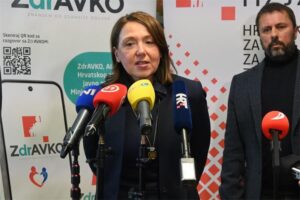
In its first month, it recorded more than 7,500 users and 128,000 processed queries, with an average of over 1,300 new queries per day, while the user base grew by 27% within the first 25 days. Citizens are not only reaching out to ZdrAVKO – they are also coming back to it. What makes it special is its knowledge base, developed exclusively with expert support from the Croatian Institute of Public Health (HZJZ), as well as its barrier-free availability, 24/7/365, via WhatsApp, without the need for registration. ZdrAVKO does not provide diagnoses; its role is prevention and improving health literacy. Like with any new tool, there is room for improvement, and we are continuously working on it. What matters most to me is that it helps overcome the “white coat syndrome”: a patient who comes to a doctor prepared, with clear questions, achieves better communication and better outcomes for both sides.
- Where does Croatia stand as an EU member compared to other countries in terms of healthcare, and how is cooperation among member states reflected?
Croatia is above the European average in key indicators of citizens’ health protection: public healthcare financing accounts for 85% compared to the EU average of 80%, while out-of-pocket payments by citizens are among the lowest in the EU. A solidarity-based financing system that protects citizens from high costs carries particular value. An equally strong asset is digitalization. According to the Digital Decade Index for 2025, Croatia has achieved 86.55% of its targets in access to eHealth records, exceeding the EU average of 82.7%. The area where we see room for improvement is the level of technological equipment, which is precisely what this current cycle of capital investments is addressing.
European cooperation shows that Croatia is not merely a recipient of European standards, but an active participant making concrete contributions. For example, the Rijeka University Hospital Centre is a European reference centre for kidney transplants, performing more than 200 procedures annually and having one of the shortest waiting times for transplantation in the EU. The lung transplantation programme at the Zagreb University Hospital Centre has marked 25 years as one of the most successful programmes of this kind in Europe, with patients leading fully active lives after the procedure. Certification of the Zagreb University Hospital Centre within the European network of oncology centres of excellence is planned by September 2028. Croatia also participates in the EU4Health programme, and within the framework of joint health technology assessments for expensive new therapies, we no longer conduct negotiations individually, but as part of the EU bloc. As previously mentioned, Croatia is also entering the European Health Data Space, which will ensure continuity of care for patients even when they are outside their home country.
- The topic that has attracted significant attention in recent months is the supplementary work of physicians. The regulation already exists, and you have opted for normative guidelines. How is implementation progressing and what is the situation on the ground?
The 2016 regulation is still in force. The new guideline provides a solution to inequalities that arose in practice due to descriptive and difficult-to-measure criteria, which led to inconsistent application, which was not fair to doctors or to patients. Instead, the criteria are now clear and measurable, directly linked to waiting times for appointments: where waiting times are shorter, more approvals may be granted; where waiting times are longer, the approval rate is reduced or approval is temporarily not issued. With this measure, we are introducing order, measurability, and accountability, with one priority in focus: the interest of patients, while still respecting professional requirements. The first impact assessments are expected after the end of the first quarter, with full effects by the end of the first half of the year. The integration of private healthcare institutions into CEZIH – expected to be fully implemented as of 1 January 2027 – will also provide an objective time stamp for every medical report, raising the transparency of the entire system to a new level.

- How would you assess the overall health of Croatians? Data on the consumption of anxiolytics is particularly concerning.
On the positive side, the five-year survival rate for all types of cancer has risen to 59% in Croatia, compared to 44% at the beginning of the 2000s. This is a step forward, showing that preventive programmes, oncology infrastructure, and access to new therapies are truly changing treatment outcomes. Participation in preventive programmes is increasing, and life expectancy is also rising. However, longevity alone is not a sufficient measure: the key question is how much of those years are lived in good health.
When we look at the state of mental health, anxiolytics have indeed become the most frequently prescribed group of medicines. This statistic is not an indication of medical failure; it reflects chronic stress, including the legacy of the pandemic, the Zagreb and Petrinja earthquakes, as well as economic pressures. Physicians prescribe them according to medical indication. However, a system that aims to be effective must act even before a person reaches the doctor’s office.
We made key structural advances in this area. We returned the psychologists to primary healthcare centres, where psychological support is provided free of charge and without a referral. So far, around 30,000 services have been delivered, and by the end of 2026 the goal is to cover all primary healthcare centres across Croatia. We are also developing a network of mobile psychiatric teams and community-based mental health outpatient units. To make this support system accessible even to those who are still hesitant to seek help, there is also ZdrAVKO – a tool that helps citizens recognize the right moment to seek professional assistance without fear or stigma. A Croatia that invests in the health of its citizens, builds modern medical infrastructure, and actively participates in European health networks is an attractive partner and a secure destination for long-term investment. And I am convinced that this a language your readers not only understand but also value.