Three days of inspiration, more than 1,500 participants and more than 100 speakers from Croatia and the world – the fourth edition of Women’s Weekend once again transformed Rijeka into one of the most important regional meeting places for ideas, inspiring people and conversations that drive change. The program brought a wide range of topics – from financial independence, leadership and technology to pop-cultural phenomena such as digital “brain rot”, but also serious social issues such as femicide and violence against women. A new program unit – interactive workshops – also aroused great interest among the participants.
Without filters and without silence: shame, the body and the responsibility of society
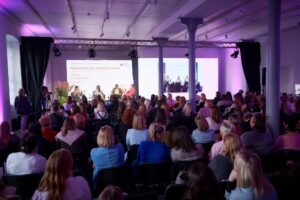
One of the most important discussions of the festival opened the issue of femicide and the responsibility of society. The panel “We failed! – Femicide: where did we fail and what society must do” was addressed by lawyer Una Zečević, theater director and professor at the Academy of Arts and Culture in Osijek Anica Tomić, and Ana Pecotić, therapist, activist, author and owner of the House of Branding agency. In an interview with journalist Hrvoje Krešić, the participants warned that narratives that romanticize violence are deeply rooted in culture and society, but also that the system often does not react decisively enough. “Culture and literature have been romanticizing jealousy and obsession for centuries, depicting violence as a ‘crime of passion’, which normalizes such patterns in society,” Anica Tomić emphasized. Ana Pecotić warned of worrying social attitudes, citing data showing that 31 percent of men from Generation Z believe that a woman must obey a man, while as many as 43 percent of girls from the same generation think it is normal for a man to slap them once. In conclusion, she said that change starts with personal and social responsibility – with the way we raise new generations.
The words that the media choose when reporting on violence against women can directly shape the way society understands femicide – was the key message of the panel “The Neighbor Said He Was Nice and Polite”. Ema Branica (Nova TV), Karla Pudar (Zaklada SOLIDARNA), Tamara Stojanović (N1 Serbia) and Jelena Veljača (Elle Croatia) spoke on the topic, moderated by Ilija Jandrić. “Editorial staff can always decide which path to take – it is not necessary to resort to sensationalism, it is possible to report on these topics with dignity and responsibility”, emphasized Ema Branica, while Karla Pudar reminded that “femicide is not just a number in statistics, because behind every victim there is a family and a community”.
At the panel “Glitter, Gambling and Grace”, trauma therapist, advanced yoga teacher and trainer Carolyn Cowan spoke openly about the personal experiences that have shaped her life and professional work. She touched on addiction, identity and shame – an emotion that often remains hidden, but strongly influences the way we experience ourselves and the world around us. “Shame is never just one event – it spreads like waves in water and begins to shape the way we live and experience ourselves,” Cowan pointed out, warning that such patterns are often transmitted through family and society. “Sometimes we unconsciously start to see ourselves the way our parents did – and so we pass on the shame.”
The topic of the panel “Trends pass, but corrections remain: beauty, filters and real decisions” powered by EDC MOTIVA was how much social media shapes the way we perceive our own bodies today. Filip Bosna, general manager for EMEA distribution markets, Dr. Rebeka Held, plastic and aesthetic surgeon and founder of the Dr. Rebeka Held Clinic, and Lena Mrđen, Business Unit Manager at Orbico Croatia and host of the GEN B podcast, spoke about the relationship between digital trends, the perception of beauty and medical responsibility. In an interview with Antonija Blaće, the participants warned that social media creates unrealistic expectations about appearance and encourages a constant search for new aesthetic ideals. “Every week, a new aesthetic trend appears on social media – a real cacophony of expectations is created,” Lena Mrđen pointed out, while Dr. Rebeka Held added that this pressure particularly affects the younger generation: “There is a big gap between the image we see on the screen and what we see in the mirror – and that is where frustration arises.”
The final panel of this year’s Women’s Weekend, “Leave me alone!”, brought together influencer Meri Goldašić and TV hosts Antonija Blaće and Mia Kovačić in an open conversation about the pressure of perfection, the culture of commenting on women, and the need to set clear personal boundaries. On the festival stage, with moderator Nevena Rendela Vejzović, the participants spoke openly about the expectations imposed on women by society, the media, and everyday life, and about the importance of authenticity and one’s own choice. “Social pressure comes from everywhere – from family and friends to the media and social networks,” Mia Kovačić emphasized, recalling a situation in which her name suddenly appeared in media headlines related to the international “Epstein Files” affair, without anyone contacting her or checking the information beforehand. The participants agreed that many women have been trying to meet other people’s expectations for years – from their partners, families, or society – often to the detriment of their own authenticity. “When I stopped trying to be what others expected of me, only then did I become truly happy,” concluded Meri Goldašić.

Three days of powerful conversations, ideas and inspiring moments
Over the course of three days, the festival brought a series of powerful conversations, inspiring stories and moments that delighted the audience. Special attention was drawn to the icon of world gastronomy and Emmy-winning chef Lidia Bastianich, who, in a conversation with Antonija Blaće, spoke about her life journey from Istria to the United States, but also about the power of food as a universal language of connection. “My childhood was filled with the smells and tastes of life in the countryside, and it was these memories that later led me to cooking,” said Bastianich, adding that food always brings us back to what is most important – togetherness.
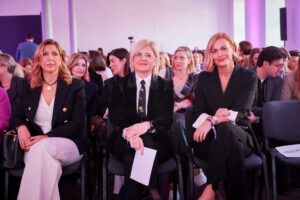
Deputy Governor of the Croatian National Bank, Dr. sc. Sandra Švaljek, was a guest on the panel “What (don’t) we know about investments? – How women shape long-term financial security”, where she, together with Dr. sc. Eva Horvat, member of the Management Board of Raiffeisen Pension Company, spoke about savings, pensions and investments in times of inflation and market uncertainty. “Financial security does not come by chance – it is the result of informed decisions, long-term planning and understanding of risks”, emphasized Švaljek.
One of the most memorable discussions of the festival was the panel “Six–Seven”, dedicated to Generation Z and digital glut. The impact of algorithms, infinite scrolling and digital trends was discussed by Jakov Jozinović, representative of Generation Z, Iva Ančić from A1 Croatia, Dr. med. Hrvoje Handl, specialist psychiatrist and subspecialist in psychotherapy, and Biljana Borzan, Member of the European Parliament. “The Internet is increasingly becoming a kind of third parent because algorithms strongly influence the emotions and behavior of young people”, warned Dr. Handl.
A festival that builds community
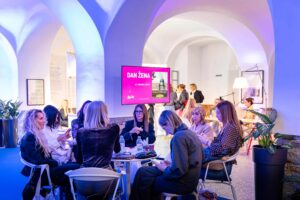
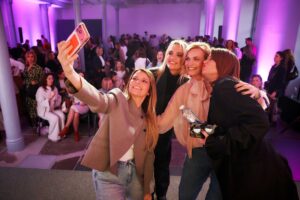
With powerful panels and open discussions, Women’s Weekend brought an energy to Rijeka’s Art Kvart this year that did not stop with the end of the daily program. Conversations continued in the hallways, at gatherings and evening events, confirming that the festival has become a place for meeting, exchanging ideas and creating new collaborations. The highlight of the evening program was the Women’s Weekend Party at Rijeka’s Pogon Kulture, where ToMa and his special guest Ružica Maurus put on a musical spectacle that delighted the audience.
The fourth edition of Women’s Weekend once again confirmed its position as one of the most important regional platforms that focuses on women, but also encourages broader social dialogue about equality, business and the future.