Croatia needs a new development model based on increasing investment in the private sector and reducing the share of employees in public administration, all in order to boost exports and strengthen competitiveness.
The Croatian Employers’ Association (HUP) has been a strong promoter of Croatian economy for 33 years, as well as a responsible social partner, an advocate of economic and public policies of broader interest, as well as an independent critic and corrective force of the government, says Assoc. Prof. Dr. sc. Mislav Balković, President of HUP and Rector of the Algebra Bernays University, in an interview for Diplomacy&Commerce. HUP member companies generate around 80% of Croatia’s GDP, which in itself demonstrates our role and position within the economy.
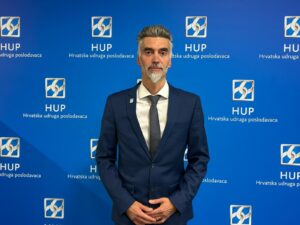
- You assumed the presidency of HUP in October last year, after serving as a member of the Executive Board. In your view, what is the role of HUP in Croatian society and the economy, and where do you see HUP today in terms of its activities and influence?
HUP plays a significant role in the tripartite social dialogue, as since 1994 it has been the sole representative employers’ association in Croatia. We operate within the Economic and Social Council, which was established to protect and promote the economic and social rights of employers and employees. As an independent representative of employers, HUP also has the right to engage in collective bargaining and to conclude collective agreements. With 30 industry associations, regional offices, and strong analytical activities, HUP today represents a powerful entrepreneurial network covering nearly all aspects of modern business. The development of entrepreneurship, investment growth, increased competitiveness, employment, and the creation of added value are our key objectives, and we aim for them to become central priorities of society as a whole. Entrepreneurs are the ones who employ people, create new jobs, generate new value, build a better business environment, and lay the foundations for improving the standard of living for all citizens. That is our core mission, and I believe that over these 33 years we have been quite successful in fulfilling it.
- What do you consider to be the biggest challenges facing the Croatian economy, and which tools would you propose to address them? Which sectors and industries are the most critical?
By achieving high growth rates and faster convergence with the more developed EU member states, Croatia is fulfilling key foreign policy and economic objectives. However, there is still much work to be done domestically. I am referring here primarily to the continuation of reform policies and the adaptation of the economy to an increasingly demanding international market. We expect a more efficient and cost-effective public and local administration, a predictable and stimulative tax and regulatory framework, and consistent implementation of adopted reform laws and regulations. We have to be more prepared to change and adapt to the world; only in this way can we leverage all the advantages and mitigate the drawbacks of a small and open economy like ours. In recent years, a significant portion of our economic growth has come from public sector investments, largely funded by EU funds. In the past two years, as much as ¾ of Croatia’s economic growth came from the public sector, while only ¼ came from the private sector. At the Croatian Employers’ Association (HUP), we believe this is not a sustainable development model. The key to continued economic growth – and, consequently, an improved quality of life – lies precisely in investments in the private sector. To be completely specific: unless the private sector becomes the main engine of growth by increasing productivity and competitiveness – which is directly linked to necessary investments in technology, knowledge, and better management, as well as the efficiency of public administration – it will be difficult to exceed the current level of around 80% of the EU average.
As concrete examples, I would highlight the urgent need to transform domestic agriculture, the need for increased allocation to the economy and its competitiveness in the next EU multiannual financial framework, and the need to ensure stable and more affordable energy supply. Namely, a significant number of our entrepreneurs pay electricity prices that are 18% higher than the average paid by our EU competitors, making it difficult to compete. It is therefore unsurprising that the higher cost of energy is reflected in the prices of products and services. In terms of economic policy, we expect further tax relief on labour and a reduction of para-fiscal charges that weigh on entrepreneurs, as well as replacing these revenues with significantly stronger taxation of short-term tourism rents. An urgent exit from horizontal price control measures on food products is crucial for the survival of our food industry, as such an approach has evidently not yielded significant social benefits, while imports of cheap and lower-quality food have significantly increased. We need a new development model and the urgent halting of the exponential growth in labour costs in the public sector, which, in terms of share in GDP, has made Croatia the second most expensive EU member state and has spilled over into the private sector. Government interventions, such as record breaking increases in the minimum wage – significantly faster than productivity growth – have not helped the competitiveness of the economy. In conclusion, Croatia needs a new development model based on increased investment in the private sector, reducing the share of public sector employment to the level of EU or OECD countries, privatization of part of public enterprises to align employment shares with EU or OECD standards, all with the aim of increasing exports and strengthening competitiveness.
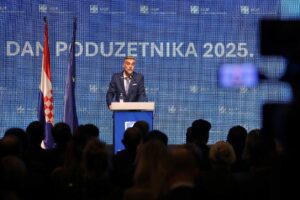
- The shortage of labour is a major problem for the Croatian economy and society. The Government of Croatia has introduced certain regulations to better manage this area. Do you agree with the Government’s measures, and what are HUP’s proposals for more effective action?
Although some trends, such as the return of emigrants and a slight increase in birth rates, are encouraging, Croatia still requires foreign labour. This need is not only for lower-skilled positions and specific sectors like construction or tourism, but also for highly educated and skilled professionals. Unfortunately, of approximately 135,000 foreign workers in Croatia, less than 1% of them hold a higher education degree, indicating that we are not attractive to such workers. Moreover, Croatia ranks at the bottom of Europe in attracting foreign students who come to obtain a degree. This, however, is the only sustainable and successful model for attracting foreign talent and integrating them into society, and we hope that Croatia will finally recognize this as a strategic priority, as our EU competitors have successfully done.
We welcome many measures that have a positive effect on labour market stabilization, including stricter entry criteria and controls for foreign workers, as well as sanctions for irresponsible employers. Nevertheless, numerous problems and uncertainties remain, from the slow process of issuing student visas and work permits, to locally inconsistent interpretations of regulations and rulebooks, to certain measures that have proven difficult to implement in practice. We commend the possibility of work permits valid for up to 3 years and the introduction of long-term D visas for students, which should significantly increase the percentage of visas issued to students compared to the previous practice of using short-term Schengen C visas for this purpose. Our goal is to retain as many high-quality workers as possible, ensure their security, and provide integration into our society. We support measures for learning the Croatian language, but integration doesn’t end there, it is a two-way process; foreign workers must feel welcome and accepted in our society, and we as a society must adapt and accept the fact that foreign labour is necessary if we aim to grow our economy and standard of living. Given that over the past decade we have lost as much as 19% of our secondary school population, serious demographic challenges – particularly regarding the highly educated – lie ahead if we do not start viewing students coming from outside the European Economic Area (EEA) not as a security risk, but as essential talent needed to fill high-skilled positions in the economy.
- When highlighting business challenges, inflation is certainly one of the key issues. How do employers, given their important role in the price formation chain (production, services, etc.), view this problem, and how can it be addressed?
Unfortunately, high growth rates are always accompanied by inflation. Part of this is due to imported factors, and part is specific to conditions in Croatia. Inflation in Croatia has been driven by an imbalance between supply and demand, particularly in the construction sector, as well as by strong tourist consumption, rising energy costs for the economy, and service prices following the introduction of the euro. An additional complicating factor, which we at HUP have repeatedly highlighted, has been the explosive growth of wages in the public sector, coupled with the EU-record increase in the minimum wage, instead of a gradual increase aligned with other factors, such as the efficiency growth of public administration. When you factor in the second-highest VAT rate in the EU, electricity prices for businesses that are 18% higher than the EU average, a minimum wage increase of over 100% in the past six years, and increased demand due to large public investments, you get a recipe for inflation.
- Recently, the Secretary-General of the Organisation for Economic Co-operation and Development (OECD), Mathias Cormann, visited Croatia, during which the second economic review of the country’s accession process was conducted. How important is joining the OECD for Croatia, and how will it impact the prosperity of the country, its economy, and its citizens?
Croatia is in the final stage of the OECD accession process. The latest report emphasizes that, beyond meeting formal requirements, maintaining momentum in implementing structural reforms will be crucial. Most of the recommendations align with HUP’s positions and concern the need for stricter fiscal policies, optimization of local government units, judicial and educational reform, and improvement of corporate governance standards along with the privatization of some state-owned enterprises, as well as the urgent removal of harmful price control measures, which in the EU are now found only in Croatia and Hungary. Membership will enable further economic growth, strengthen exports and competitiveness, positively affect the credit rating, and support continued investment growth and improvements in living standards.
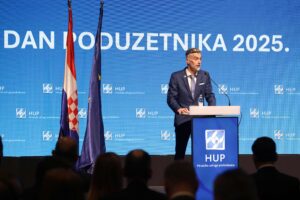
- The application of artificial intelligence (AI) and algorithmic management is increasingly shaping the labour market, and the key challenge remains how to align technological development with worker protection and economic competitiveness. What is your personal view on the role of AI, and where does Croatia stand globally?
We are living in a time of technological and social revolution. I believe we are approaching a rapid realization of the speed and impact of technological changes and a reassessment of the belief that, in this technological revolution, every job lost to automation will be replaced by a new and even better one, like it happened after the 18th-century Industrial Revolution. Despite the retention of jobs, the speed of technological change then caused major social upheavals that the societal structures of the time – primarily feudalism and monarchy – could not withstand. Fundamentally, the challenge and driver of social disruption during the Industrial Revolution are the same today in the era of the digital revolution. This is personal insecurity and concern for the future, in which many of us wonder whether technology will take our jobs and livelihoods. This very uncertainty forms the basis for the rise of populism and nationalism worldwide, as well as widespread fear of the future.
The responsibility of public policymakers, as well as entrepreneurs, to ensure the timely transformation of business operations, investment in education, and adoption of new business models and technologies under such conditions goes far beyond mere concern for corporate well-being or, if you will, profitability. The aspects of technological change that may arise from significant increases in productivity and reductions in employment due to the introduction of artificial intelligence, humanoid robots, and other tools and technologies are, at the very least, twofold: economic on one hand, and social and sociological on the other. Therefore, in the coming period, Europe and Croatia must find a balance between regulation and development in order to catch up with current leaders in this field, who, unfortunately, are further increasing their advantage. This topic requires a broader societal consensus and a clear plan of action that could also be supported by resources from the new EU programming period. In this regard, HUP is fully prepared and willing to expand the role of its commission, which is already examining various aspects of the development and impact of artificial intelligence, into a wider societal function, should such a need be recognized.